
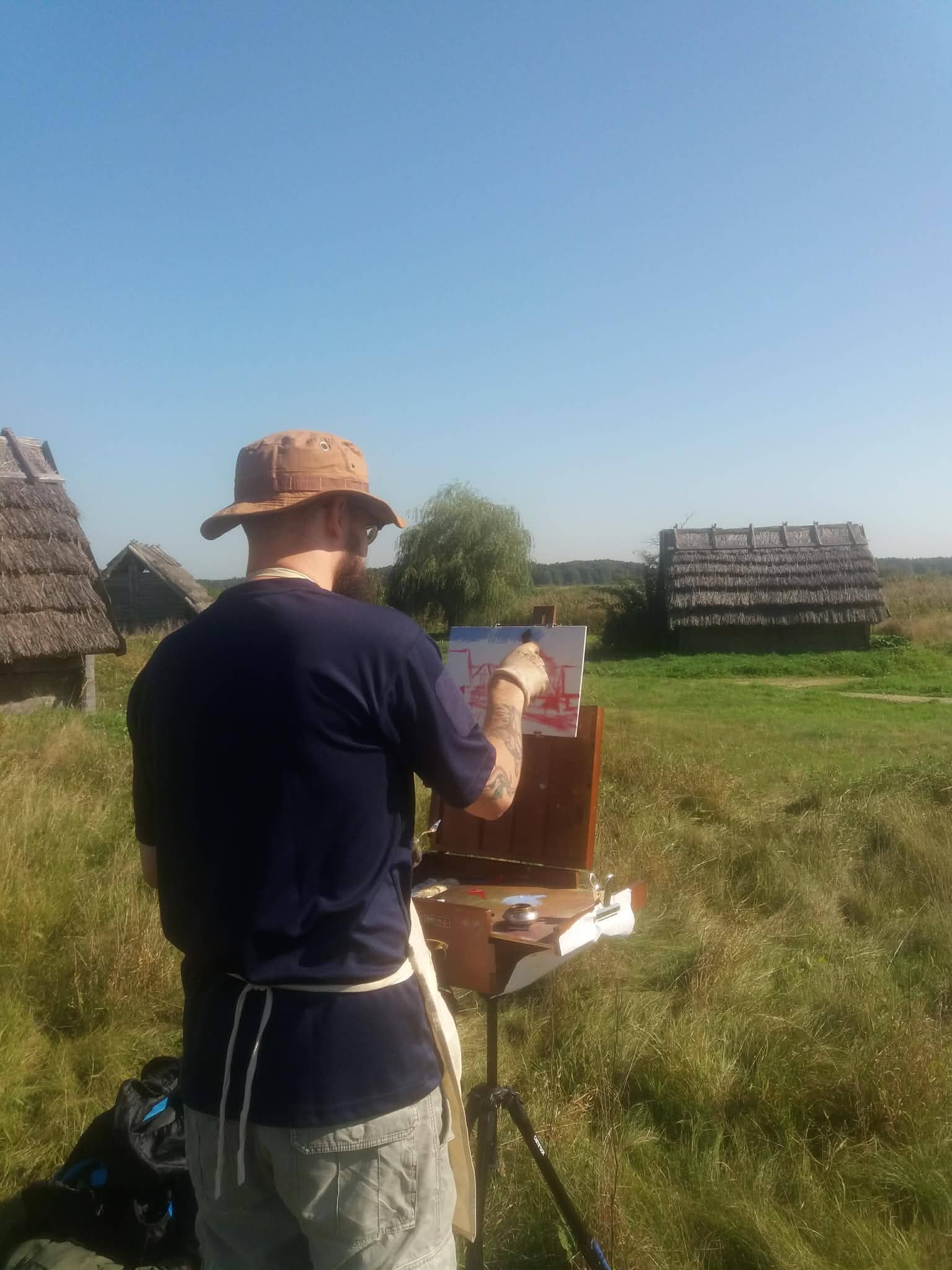
Independent five-year plein air equipment review
I bought the Jack Richeson Sienna All-in-One Pochade Box in 2021. Since then it has travelled through Poland and Italy, supported roughly 100 paintings, survived winter snow, Sardinian heat, strong coastal wind and several falls — including two drops onto concrete. This long-term review explains what held up, what became irritating and what I would redesign after five years of real use.
I purchased this pochade box with my own money. This review is not sponsored, contains no affiliate links and was not approved or supplied by Jack Richeson, Sienna Plein Air or any retailer.
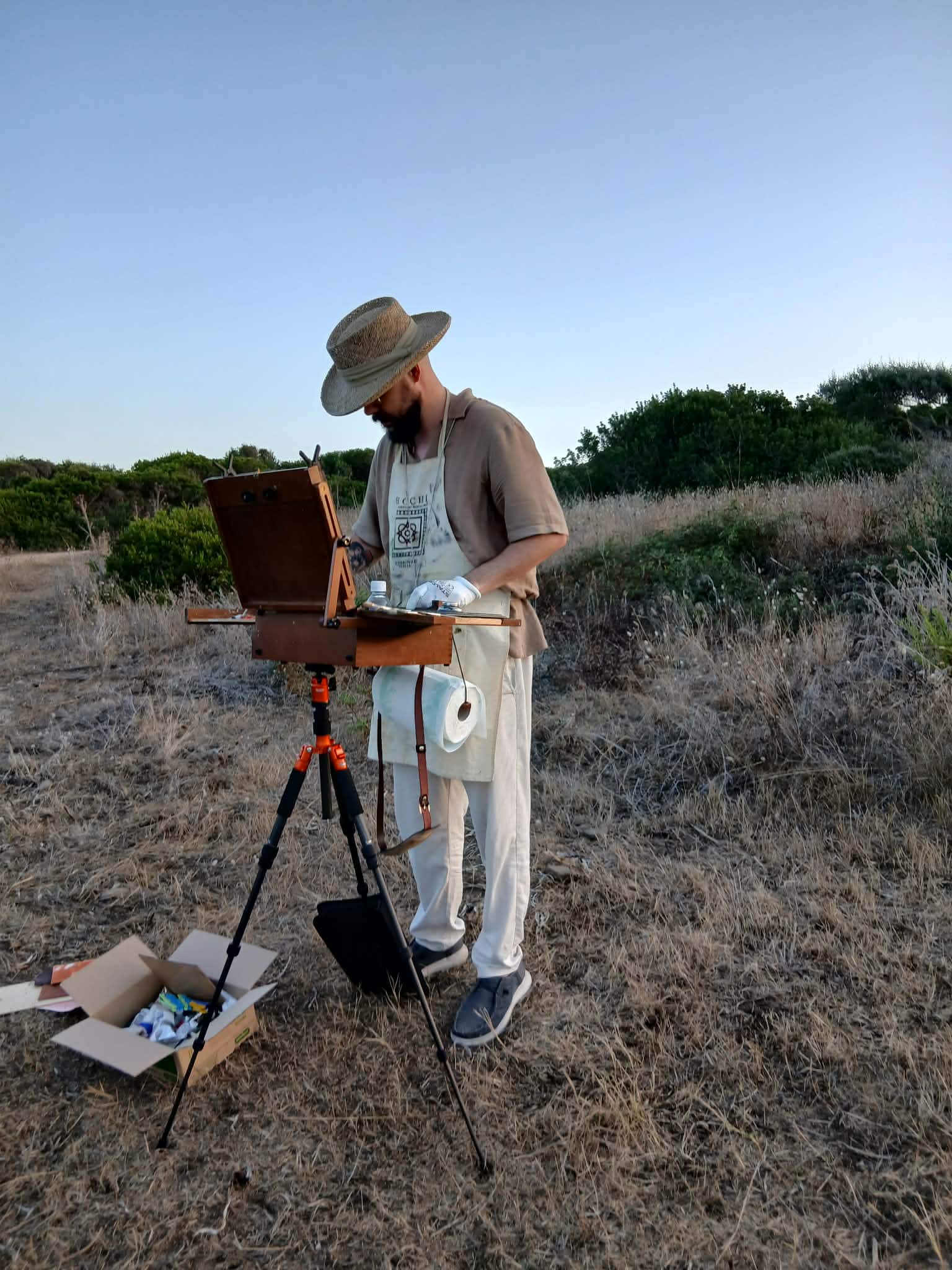
Quick verdict
The Jack Richeson Sienna All-in-One is not an ultralight pochade box, and it is not perfect. Its brush tray is the weakest part of the design, long-handled brushes do not fit comfortably inside, and the right-side pull-out palette is not ideal for the way I work.
However, its construction has proved exceptionally durable. The box remains rigid, the hinges and screws are still tight, the finish has resisted years of use, and the integrated storage makes it possible to carry a surprisingly complete oil-painting setup in one wooden case.
Would I buy it again? Yes — but I would like a revised version with better brush storage, secured dividers and a reversible palette.
Why I chose the Jack Richeson Sienna All-in-One Pochade Box
Before buying the Sienna, I had used a traditional French box easel. I also considered pochade boxes by Guerrilla Painter, Alla Prima and MEEDEN. The Jack Richeson Sienna All-in-One won mainly because it appeared to offer a strong combination of price, storage capacity, positive reviews and visual quality.
Appearance is not the most important feature of painting equipment, but it does matter when an object becomes part of your working routine. The wooden construction, brass-coloured fittings and compact suitcase-like form made the Sienna feel more like a durable artist’s tool than a piece of temporary outdoor equipment.
I began painting outdoors out of curiosity. It quickly became one of the most important parts of my painting practice . Working from life is demanding, but it is also highly educational and, at times, almost meditative.
A good pochade box does not make the painting easier, but it removes enough organisational friction to let you concentrate on colour, light and the changing landscape.
Five years of real-world plein air use
I cannot give an exact number, because I also use the box indoors for smaller works, but approximately 100 paintings have been made on it. At quieter times I used it several times per month. During more active periods it could be used two or three times per week.
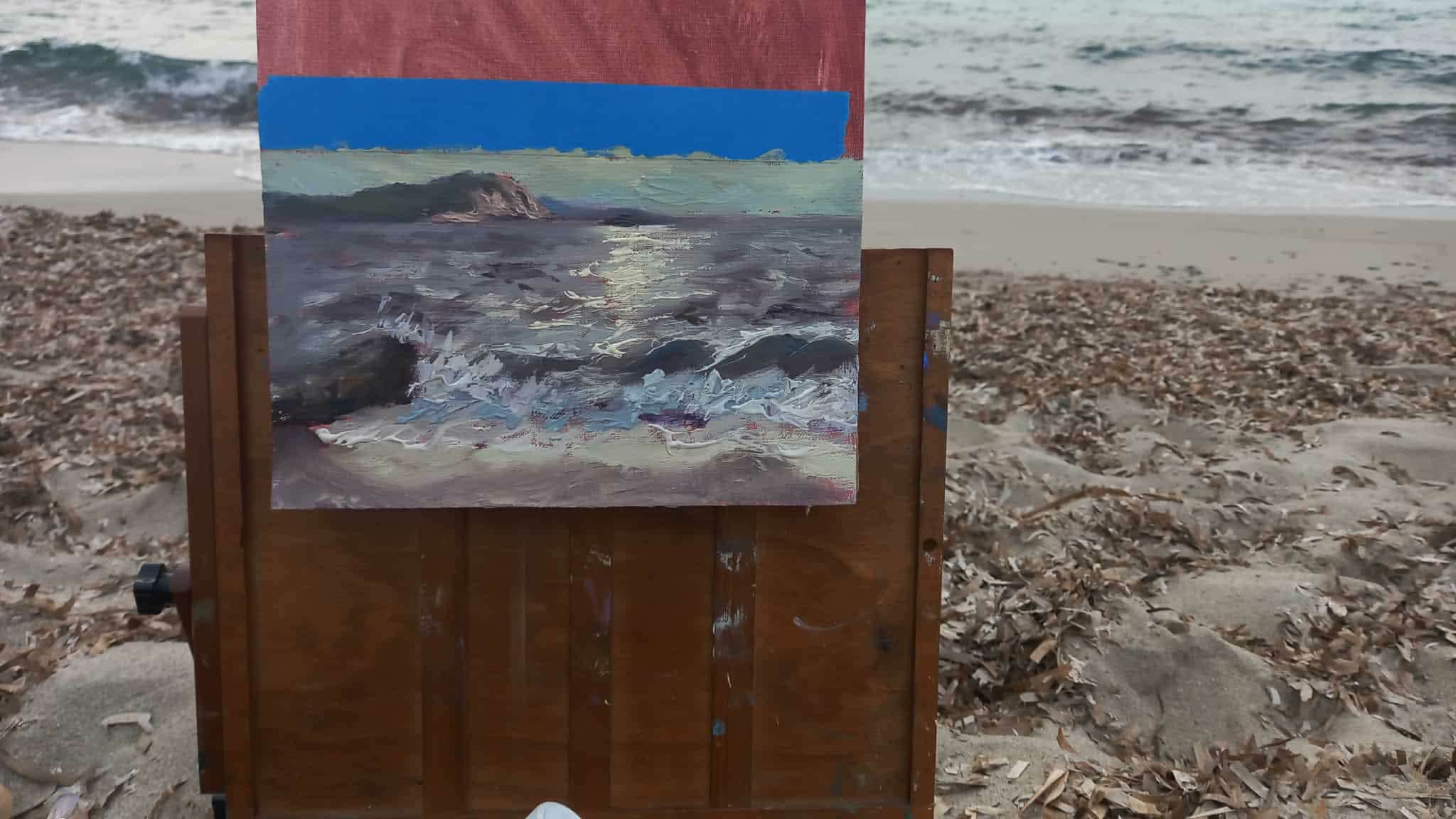
It has travelled through Poland and several parts of Italy, including Tuscany, Lombardy and Sardinia. It has been carried on the shoulder, packed into a backpack, transported by bicycle and placed in a car. It has worked beside beaches, fields, wetlands, roads, rocky coastlines and winter rivers.
Many of the landscapes created with it became part of my collections of Tuscan landscape paintings , Sardinian oil paintings and Mediterranean landscape and seascape paintings .
That matters because a review based on opening a new box in a studio cannot reveal much about long-term reliability. The relevant question is not whether the wood looks attractive on the first day. It is whether the hardware stays tight, the joints remain rigid and the box still functions after years of paint, transport, dust, humidity and accidental impacts.
Durability and build quality: the strongest part of the box
Durability is where the Sienna All-in-One has impressed me most. The box has fallen approximately six or seven times. Two of those incidents were onto concrete: once from roughly knee height and once from around waist height.
The higher fall happened while I was carrying several things on my way to the Academy of Fine Arts in Kraków. The shoulder strap slipped, and I expected to see pieces of wood and hardware scattered across the pavement. Instead, the box remained intact. The damage was limited to a minor scratch.
Nothing bent. The wood did not split. The hinges, screws and connecting elements remain firm after years of use, and I have not had to repeatedly tighten loose hardware.
The protective finish has also held up very well. Most of the visible wear is simply accumulated paint inside the box, which is exactly what should happen to working equipment.
Setup time, stability and portability
Setting up the complete kit usually takes me around five to ten minutes. Mounting the box securely to the tripod, extending the supports, positioning the brush tray and organising paper towels or other loose materials takes longer than opening a minimal panel holder.
I would not call this a major problem. A larger all-in-one pochade box will always require more preparation than a stripped-down ultralight setup.
The advantage is that, once open, the Sienna becomes a compact working station containing paint, brushes, solvent, palette knives, drawing tools and wet-panel storage.
It is stable on a tripod and can also be used on a table, chair or other firm surface. I normally paint for one or two hours at a time, and the box gives me enough working space without feeling like a full French easel.
It is not a super-light setup. Painters who want to hike long distances with the smallest possible load may find it excessive. I prefer carrying more paint, more brushes and a broader range of tools, so the weight suits the way I work.

Palette size and mixing space
The pull-out wooden palette offers enough room for the way I mix oil paint. I regularly use Michael Harding, Rembrandt, Maimeri Classico and Master Class colours, and I prefer having several pigments available rather than reducing the kit to a few tiny tubes.
Cleaning the palette is straightforward when done regularly. My own problem appeared only after several years of allowing dried paint to accumulate.
At one point the layer had become several millimetres thick. Removing it chemically was possible, but the paint came away layer by layer. This was not necessary for normal use; I simply wanted to restore the appearance of the bare plywood.
Accumulated paint can also make the sliding palette stick against the internal walls. After a longer break, I sometimes have to use more force than I would like to pull it out.
Storage and the integrated wet-panel compartment
The internal storage is one of the main reasons the All-in-One model has remained useful. I normally keep oil paints, brushes, a viewfinder, a solvent container, a pencil and several palette knives inside.
Paper towels, tape, a utility knife, clamps and loose pieces of linen usually travel in a separate backpack.
The built-in wet-panel compartment is particularly valuable. It allows fresh paintings to be transported without requiring a separate carrier. I mainly paint on 4 mm HDF panels prepared with linen, although I have also used thicker MDF supports.
Because the compartment was designed around common American panel dimensions, I added several simple wooden spacers. These let me secure smaller European formats and prevent them from moving inside.
How it handles snow, rain, heat and Sardinian wind
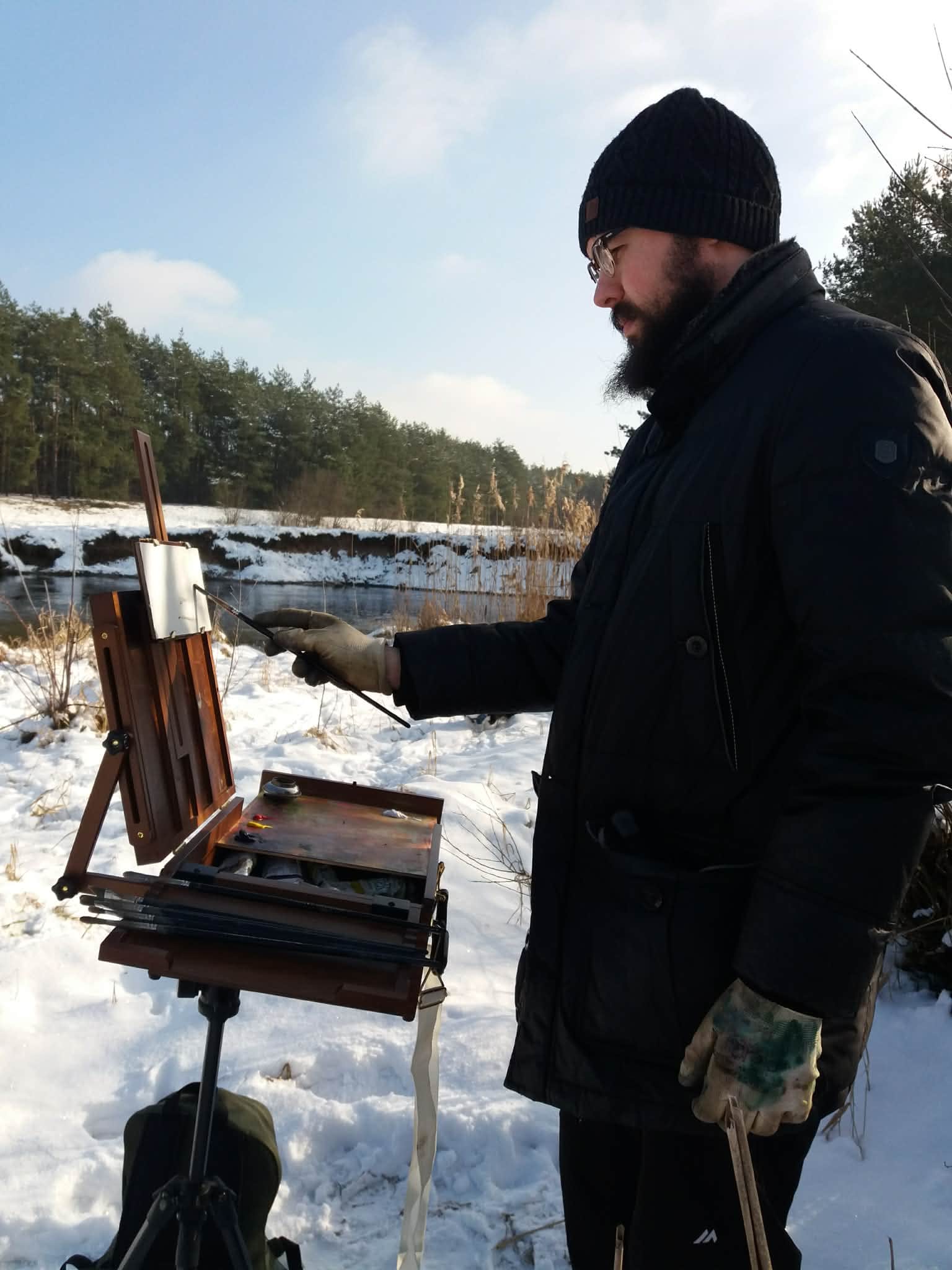
The box has been used in winter snow, high summer temperatures, brief rain and strong coastal wind. Heat in Sardinia caused no problems, and the metal components have not developed visible corrosion or unpleasant squeaking.
I also used it during a short period of rain. The session lasted only around twenty minutes, after which I dried the wood carefully at home. The box showed no lasting reaction to that exposure.
Wind is a different matter. During the Sardinian mistral, a 40 × 50 cm panel created too much surface area and made the complete setup feel unsafe. I quickly returned to the smaller formats I normally use outdoors, and the problem disappeared.
Jack Richeson Sienna pochade box problems after five years
No long-term review is useful without discussing what becomes annoying. The Sienna’s weaknesses are not failures of the main wooden structure. They are smaller design decisions that repeatedly interrupt the working rhythm.
1. Long-handled brushes do not fit
I like long-handled Rosemary & Co brushes, but the internal storage is approximately two or three centimetres too short for many of them.
I eventually bought shorter-handled brushes specifically for the box because I did not want to cut the brushes I already owned.
2. The brush tray is the weakest element
The external brush support feels flexible, unstable and less refined than the rest of the construction.
It provides limited space and does not hold every tool as securely as I would like. The box deserves a more substantial integrated solution.
3. The palette pulls out to the right
As a right-handed painter, I would prefer the palette to slide out on the left.
Reaching toward paint tubes or tools on the right can force my hand and arm over the mixed paint. A reversible left-or-right configuration would suit different painters much better.
4. Internal dividers can move
The small internal dividers are not always securely fixed. They can shift, and occasionally an object becomes trapped underneath one.
This is not a serious structural fault, but it is irritating in a product designed around efficient storage.
What I would change in a Sienna All-in-One 2.0
My first change would be a stable brush compartment that slides directly out of the body of the box.
It should function as a proper drawer rather than a flexible attachment, with enough length for long-handled brushes and secure positions for palette knives.
The second improvement would be a reversible palette. Letting the painter choose whether it extends to the left or right would make the box more comfortable for both right-handed and left-handed workflows.
I would also add two or three centimetres to the useful internal brush length and secure the storage dividers so that they cannot shift or allow small objects to jam underneath.
| Current element | Problem | Suggested redesign |
|---|---|---|
| Brush tray | Flexible, unstable and limited in capacity | Rigid slide-out drawer integrated into the box |
| Brush storage | Several long Rosemary brushes are 2–3 cm too long | Slightly longer internal compartment |
| Pull-out palette | Right-side extension conflicts with my workflow | Reversible left/right installation |
| Internal dividers | They move and can allow objects to become trapped | Locking or fixed modular dividers |
| Wet-panel storage | Based mainly on American panel dimensions | Adjustable stops for European and US formats |
Who is the Jack Richeson Sienna All-in-One Pochade Box for?
It makes sense for painters who:
- want one box to hold most of a working oil-painting kit;
- value storage and durability more than the lowest possible weight;
- paint small and medium panels outdoors;
- want integrated wet-panel transport;
- travel mainly by car or walk moderate distances;
- also want to use the pochade box indoors.
It may not be ideal for painters who:
- need an ultralight hiking setup;
- only use very long-handled brushes;
- want to begin painting within one or two minutes of arriving;
- regularly use large panels in strong wind;
- prefer a minimal palette with almost no stored equipment.
I would recommend it to both beginners and experienced painters, provided they understand what kind of system it is. It is a compact portable workshop, not the smallest possible panel holder.
Examples of paintings made directly outdoors can be found in my plein air painting collection and wider oil painting portfolio .

Jack Richeson Sienna All-in-One Pochade Box FAQ
Is the Jack Richeson Sienna All-in-One Pochade Box worth buying?
In my experience, yes. After five years, approximately 100 paintings and several accidental falls, the box remains rigid and fully usable. Its main strengths are durability, integrated storage and the ability to function as a compact portable studio.
Does the Sienna All-in-One fit long-handled oil-painting brushes?
Not all of them. Several of my long-handled Rosemary & Co brushes are approximately two or three centimetres too long for comfortable internal storage. Short-handled brushes fit much better.
Is the Jack Richeson Sienna pochade box heavy?
It is not an ultralight setup, especially when filled with paint, brushes, solvent and accessories. The box itself is manageable, but carrying a complete kit through difficult terrain requires reasonable fitness.
Is it stable in strong wind?
The box is stable on a good tripod, but the painting panel size remains important. A 40 × 50 cm panel was impractical during a strong Sardinian mistral. Smaller panels worked much better.
Can the Sienna All-in-One carry wet paintings?
Yes. The integrated compartment is one of its strongest features. I added simple wooden spacers to secure smaller European panel formats inside the storage area.
How long does the pochade box take to set up?
My complete setup normally takes around five to ten minutes, including attaching the box to the tripod, extending the supports, arranging the palette and preparing paper towels and tools.
Would I buy the Jack Richeson Sienna All-in-One again?
Yes. The durability and overall quality outweigh the irritating brush tray, right-side palette and limited space for long-handled brushes.
Final verdict after five years
The Jack Richeson Sienna All-in-One Pochade Box has become a dependable part of my painting practice. Its greatest achievement is not a clever accessory or a decorative finish. It is the fact that, after years of transport, changing weather, dried paint and repeated impacts, the basic structure still works exactly as it should.
It is compact enough to travel, large enough to carry a serious selection of materials and strong enough to survive real use. The built-in panel storage makes it far more practical than carrying a separate wet-panel box, and the palette gives me enough room to mix without feeling restricted.
The design is not finished in every detail. The brush tray feels weaker than the rest of the box, the internal length limits long-handled brushes, and I would strongly prefer a reversible pull-out palette. These are genuine frustrations, not invented criticism added to make the review appear balanced.
My final assessment: the Jack Richeson Sienna All-in-One is a durable, attractive and genuinely useful pochade box for painters who want a complete portable workspace rather than the lightest possible setup.
I would buy it again, but I would welcome a redesigned version that treats brush storage with the same seriousness as the main wooden construction.
After five years, the best compliment I can give the Sienna is simple: when I arrive at a location, open the box and begin mixing paint, it no longer feels like equipment I am testing. It feels like my outdoor studio.
Explore paintings and articles from the studio
Many paintings in these collections were created outdoors or developed from direct observation of landscapes in Poland and Italy.
