

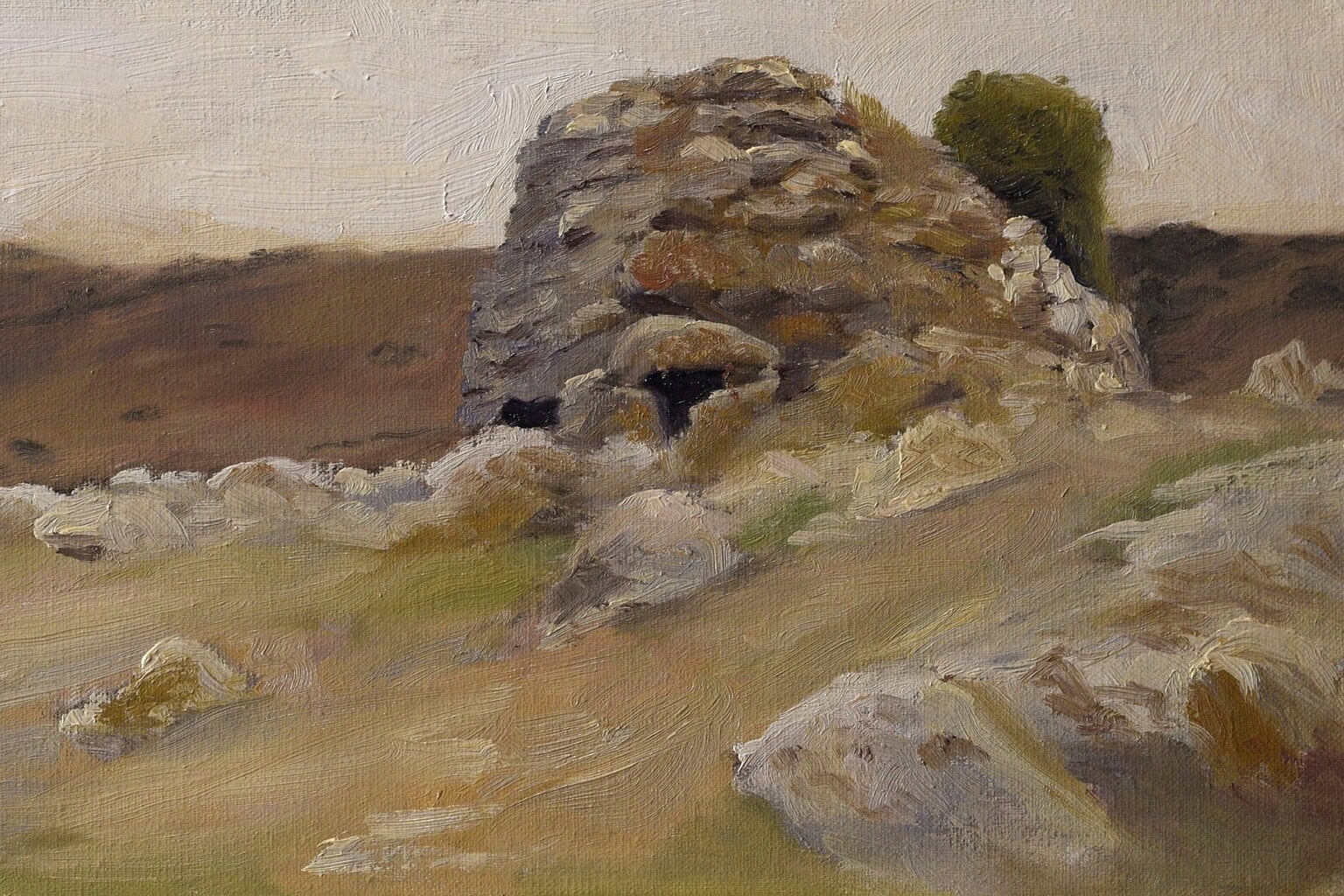
Nuraghe Izzana stands on a sun-scorched plain in northern Sardinia, among pale granite, dry pasture and low mountains. The ancient building is surrounded by a working farm. Bronze Age stone and ordinary rural life still occupy the same ground.
Nuraghe Izzana in the Burnt Plain of Gallura
I visited Nuraghe Izzana while travelling through the interior of Gallura, near Aggius and Tempio Pausania. The landscape around it belongs to the Piana dei Grandi Sassi, also known as Valle della Luna: open ground, granite boulders, rough pasture and mountains softened by heat.
What stayed with me was not simply the age of the monument. It was the lack of separation between the nuraghe and the present. There was no museum atmosphere and no attempt to turn it into a picturesque ruin. It stood inside the farm, close to tracks, fences and everyday work.
That made it feel more alive. The past had not been removed and carefully displayed. It was still there, heavy and slightly awkward, surrounded by the same hard landscape from which its stones had been taken.
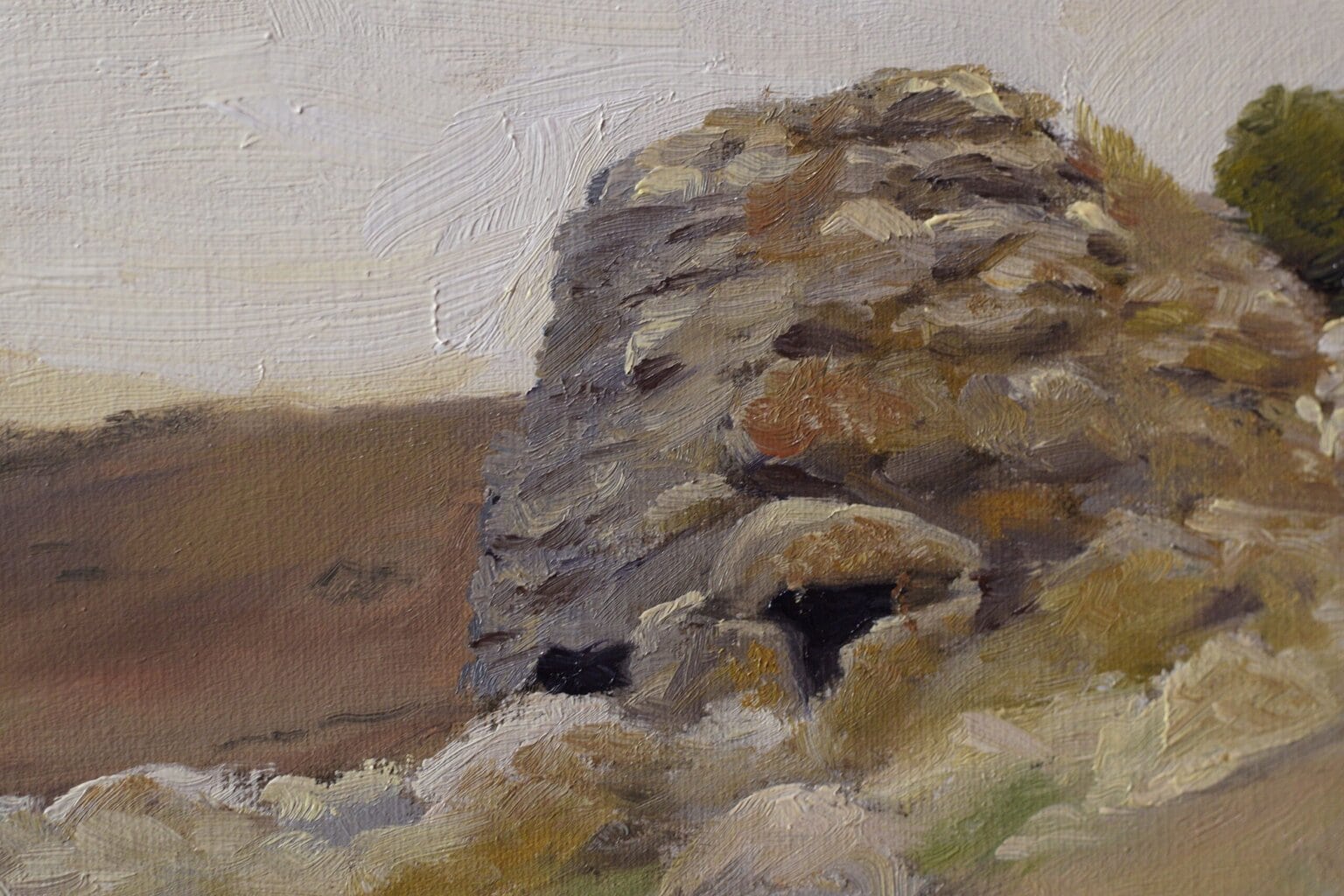
Stone, weight and two dark openings
The real nuraghe is built from massive local granite. Its unusual structure combines features associated with early corridor nuraghi and the later tholos type.
I did not want to count and describe every stone. I wanted the whole building to feel compact and heavy. The two openings became the darkest points in the painting — almost black, but small enough not to break the unity of the structure.
More information about the monument can be found on the official SardegnaCultura page about Nuraghe Izzana.
A Bronze Age Monument Inside a Working Farm
Archaeological sites are often photographed in a way that removes every sign of contemporary life. At Izzana, the farm is part of the experience. The monument, the fields and the present-day landscape exist together.
That relationship became the main idea of the painting. The nuraghe is the strongest form, but it does not rise above the land like a romantic castle. It is made from the same dirty browns, cold greys and muted greens as everything around it.
From a distance, it seems halfway between a building and a natural formation. It could almost be another outcrop of granite. Only the dark entrances reveal the human hand and the strange purpose behind the mass of stone.
The atmosphere came from something very simple: a structure built thousands of years ago still standing inside an ordinary field.

Painting Nuraghe Izzana from Photographs and Memory
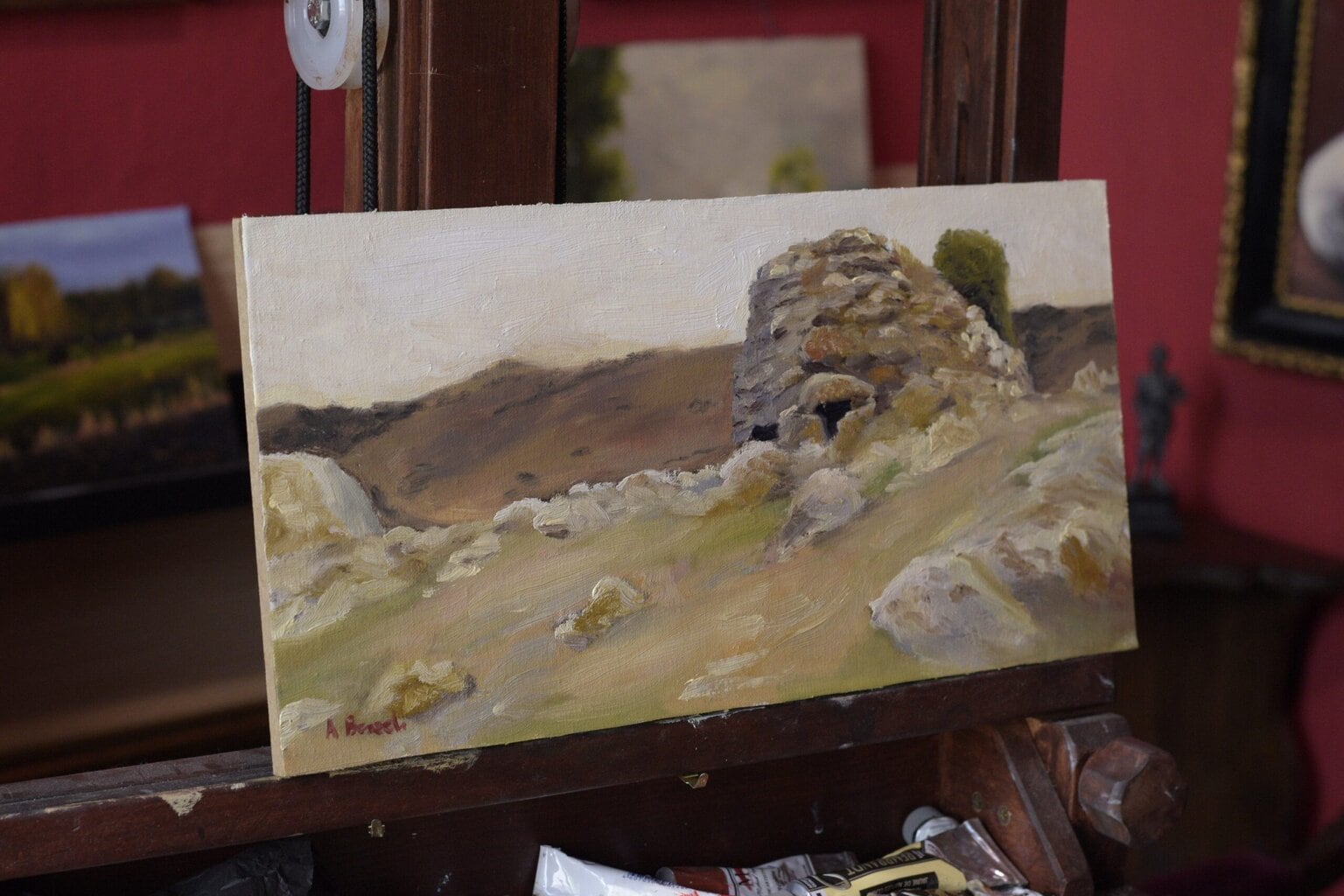
I painted Nuracu d’Izzana later in the studio. I used my own photographs, but I was also relying on what had remained in my head: the washed-out light, the rough scale of the stones and the severe openness of the plain.
I did not follow one photograph literally. The distant mountains were simplified, the field was opened up and the sky reduced to a pale strip. I wanted enough empty space around the nuraghe for it to carry real weight.
The panoramic 20 × 40 cm format helped. A more compact canvas would have turned the work into a portrait of the building. Here the structure and the plain remain equally important.
A wide palette used quietly
Although the finished painting is restrained, I did not use a limited palette. The muted colour came from mixing and neutralising warmer and cooler pigments rather than relying on ready-made browns.
Ultramarine Blue, Naples Yellow Light, Yellow Ochre, Lemon Yellow and Cadmium Lemon Yellow formed the base of the landscape. Venetian Red, Cadmium Red Light, Yellow Lake and Alizarin Crimson warmed the earth and granite. Kremserweißton, Transparent White and Titanium Buff were used throughout the pale stones and bleached sky.
I added only a small touch of Ivory Black when I needed more neutral greys. Most of the grey-violet colour in the nuraghe came instead from mixtures of Ultramarine Blue, reds, ochres and white.
Painterly Truth, Not Archaeological Illustration
An ancient stone building can easily become a trap for a painter. Every block begins to demand an accurate edge, a separate colour and its own little description. The result may be correct, but it often loses the force of the whole form.
I wanted enough information for the building to be recognisable, but not so much that the painting became an archaeological reconstruction. Some stones are clearly stated; others disappear into one larger passage of colour.
For me, the truth of the place was in the relationships: the cold openings against warmer granite, the heavy structure against the open plain and the bleached sky pressing down over everything.
The paint remains visible throughout. Thick, broken marks build the top of the nuraghe, while thinner passages allow the field and distant mountains to stay quieter. The rough surface belongs to the subject. A polished finish would have taken away some of its severity.
More Paintings and Stories from Sardinia
Gallura keeps returning in my work. The region offers much more than bright sea colour: granite, dry vegetation, sudden weather, hard light and places where history is still physically present in the landscape.
View Nuracu d’Izzana
See detailed photographs, availability and shipping information for the original 20 × 40 cm oil painting.
View the Original PaintingFrequently Asked Questions
Where is Nuraghe Izzana?
Nuraghe Izzana stands in inner Gallura in northern Sardinia, near the border between the territories of Tempio Pausania and Aggius. The surrounding granite landscape is known as the Piana dei Grandi Sassi or Valle della Luna.
Was the painting created en plein air?
No. I painted Nuracu d’Izzana in the studio using my own photographs and recollection of visiting the place. The composition was adjusted freely rather than copied from one photograph.
Is Nuracu d’Izzana an original painting?
Yes. It is a one-of-a-kind 20 × 40 cm oil painting by Andrea Bocedi, not a print or reproduction. Availability and purchasing information can be found on the artwork page .
What does the title Nuracu d’Izzana mean?
Nuracu d’Izzana is the Sardinian form used for the title of the painting. The archaeological site is more commonly called Nuraghe Izzana in Italian and English.
