
Sardinia does not give itself softly.
The light is sharp. The rocks are hard. The sea changes color with a speed that makes painting almost unreasonable. A place that seems still for a moment can suddenly become impossible to hold: turquoise turns grey, shadows move across granite, wind disturbs the surface of the water, and the whole scene loses the balance it had only minutes earlier.
This is what interests me.
When I paint Sardinian landscapes, especially in Gallura, I am not looking for postcard beauty. The island is beautiful, of course, but beauty alone is not enough for painting. What I search for is tension: the contrast between heat and silence, between the hardness of stone and the movement of the sea, between open space and physical resistance.
Sardinia has that tension everywhere.
Painting beyond the postcard
It would be easy to reduce Sardinia to blue water and bright beaches.
But when I work there, I am more interested in the weight of the place. The landscape is ancient, dry, exposed. The rocks seem older than the human presence around them. Even the sea, which can appear decorative in photographs, becomes something more unstable when observed directly.
A photograph can record the color of the water.
A painting has to decide what that color means.
This is one of the reasons I continue to paint from direct observation whenever possible. When standing in front of the motif, I have to react to more than appearance. I feel heat, wind, glare, fatigue, distance. The painting absorbs some of that physical situation.
The result is not a copy of Sardinia. It is a response to Sardinia.
Cala Pischina and the problem of blue
Blue is dangerous in painting.
It can become too easy, too pretty, too decorative. Sardinian water tempts the painter with color, but if the painting becomes only about blue, it loses structure.
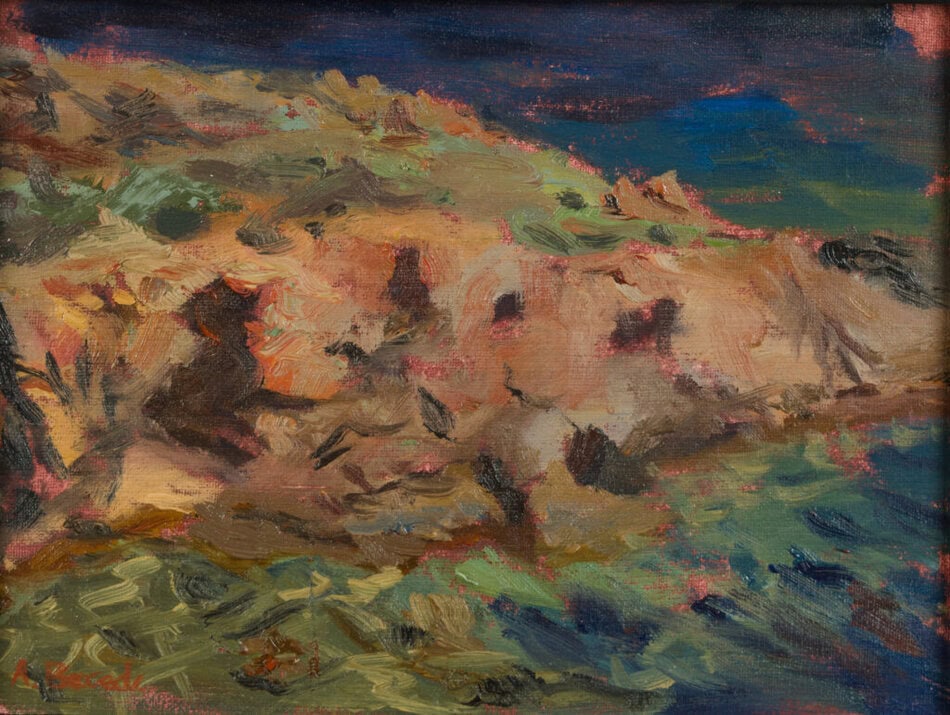
When painting places like Cala Pischina, I try to think about the whole relationship: the beach, the rock, the direction of light, the movement of water, the air between forms. The sea is not separate from the land. It presses against it. It reflects it. It creates rhythm.
In a seascape painting, the most important thing is often not the wave or the beach, but the sensation of space. The viewer should feel that the image continues beyond the edge of the canvas.
That is what makes a small seascape capable of holding a much larger world.

Granite, heat and silence
Gallura has a particular character.
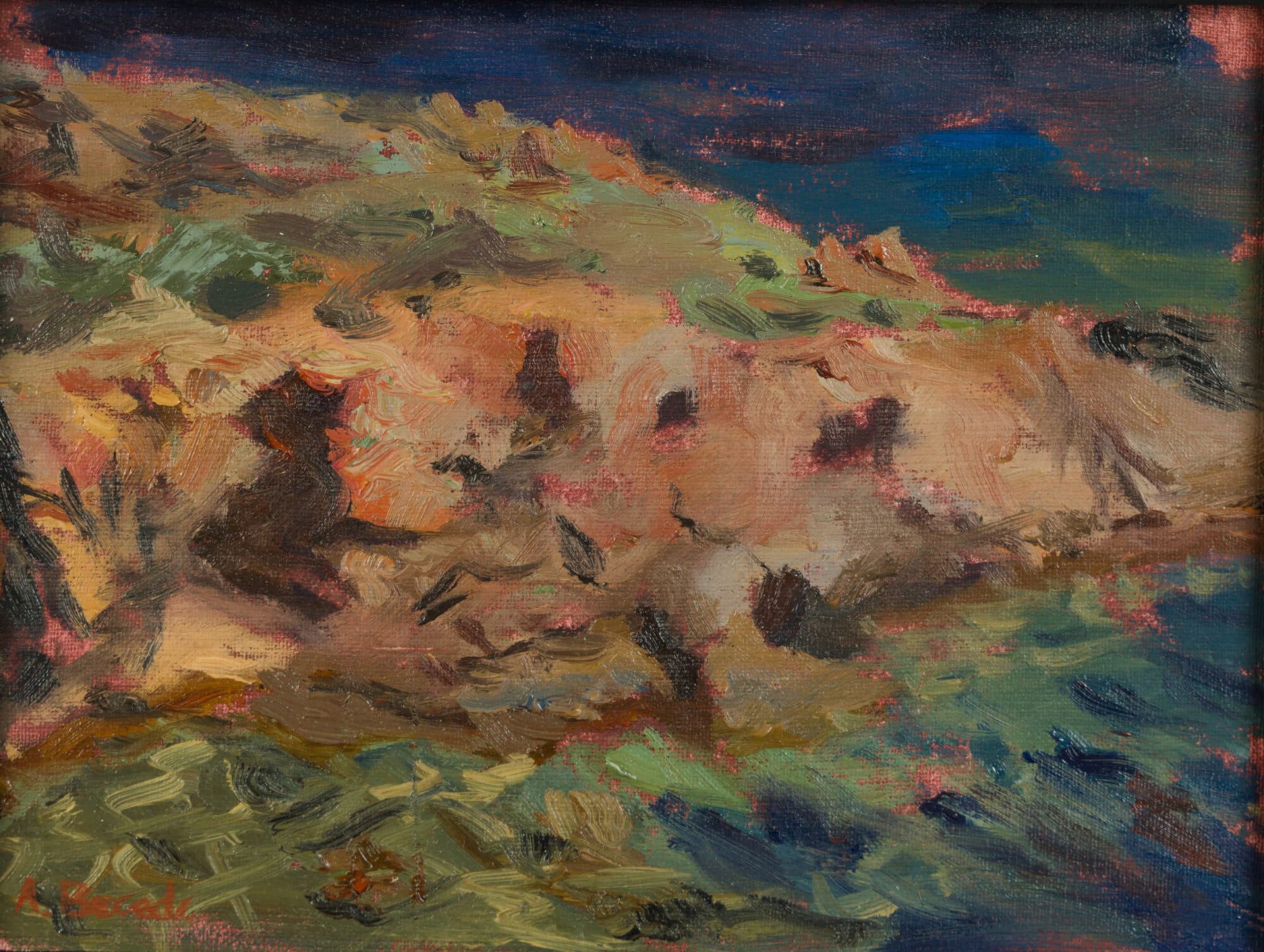
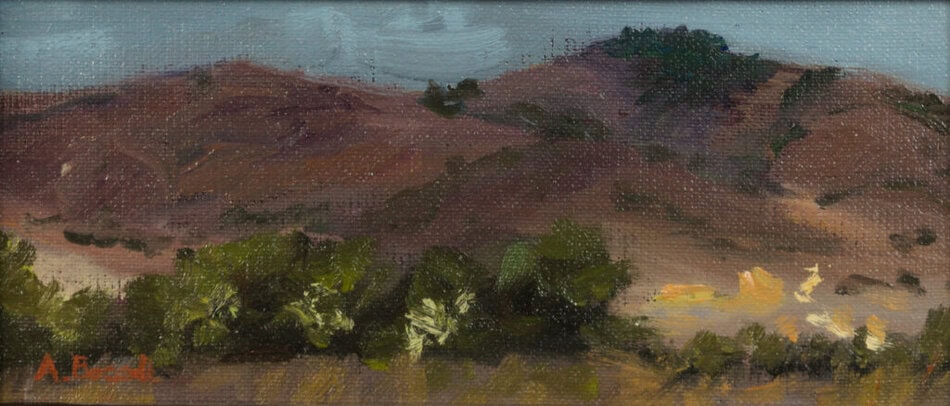
The granite forms, dry vegetation and exposed hills create a landscape that feels both rough and luminous. It is not soft countryside. It is a place of edges, surfaces and sun. Even when nothing dramatic is happening, there is intensity.
Some of my Sardinian paintings are not direct views of the sea, but landscapes shaped by the same light — hills, rocks, roads, fragments of land under a hot sky. These paintings are quieter, but they carry the same atmosphere: dryness, distance, silence.
I often think that Sardinia is not only a subject for painting, but a discipline. It forces simplification. Too much detail becomes useless. The landscape demands decisions.
Where is the light strongest?
Which shape carries the weight?
What can be left out?
How much color is enough?
These questions are not technical only. They decide whether the painting remains alive.
Why Sardinian paintings work in interiors
A Mediterranean seascape or Sardinian landscape painting can bring light into an interior without becoming superficial.
The key is atmosphere.
A painting of the sea does not have to be decorative in a shallow sense. It can create distance. It can open a room. It can introduce calm, but also energy. The best seascape paintings are not simply relaxing; they hold movement and depth.
For collectors and interior spaces, Sardinian oil paintings often work because they carry a strong sense of place. They are connected to travel, summer, heat, open air and memory — but they are still paintings first. Brushwork, surface and structure matter as much as the motif.
An original seascape oil painting is not a souvenir.
It is a physical trace of attention.
From place to painting
When I return from painting trips, the works made on location often become more than studies. Some remain as finished small paintings. Others become sources for larger studio works. Even the quick panels contain decisions that cannot be recreated later from photographs alone.
This is why I value plein air work so much. It keeps the painting close to experience.
Sardinia, especially Gallura, gave me subjects where the act of painting had to stay immediate. There was no time for overthinking. The light moved too fast, the heat was too strong, and the landscape resisted becoming polite.
That resistance is part of the painting.
Available Sardinian oil paintings
I have several original oil paintings connected with Sardinia and the atmosphere of Gallura, including seascapes, coastal views and small landscape studies. Some are direct plein air works, while others come from the memory and structure of the place.
Each painting is a one of a kind original artwork, hand-painted in oil.
For someone looking for a Sardinia oil painting, a Mediterranean seascape, or an original artwork connected with sea, light and travel, these works are not only images of a location. They are attempts to preserve the pressure of a place — the heat, silence and light that remain after the moment itself has passed.
View available Sardinian and Mediterranean oil paintings in the shop.
