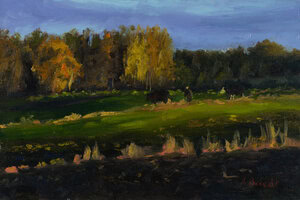
Many of the places I paint are not spectacular.
A field.
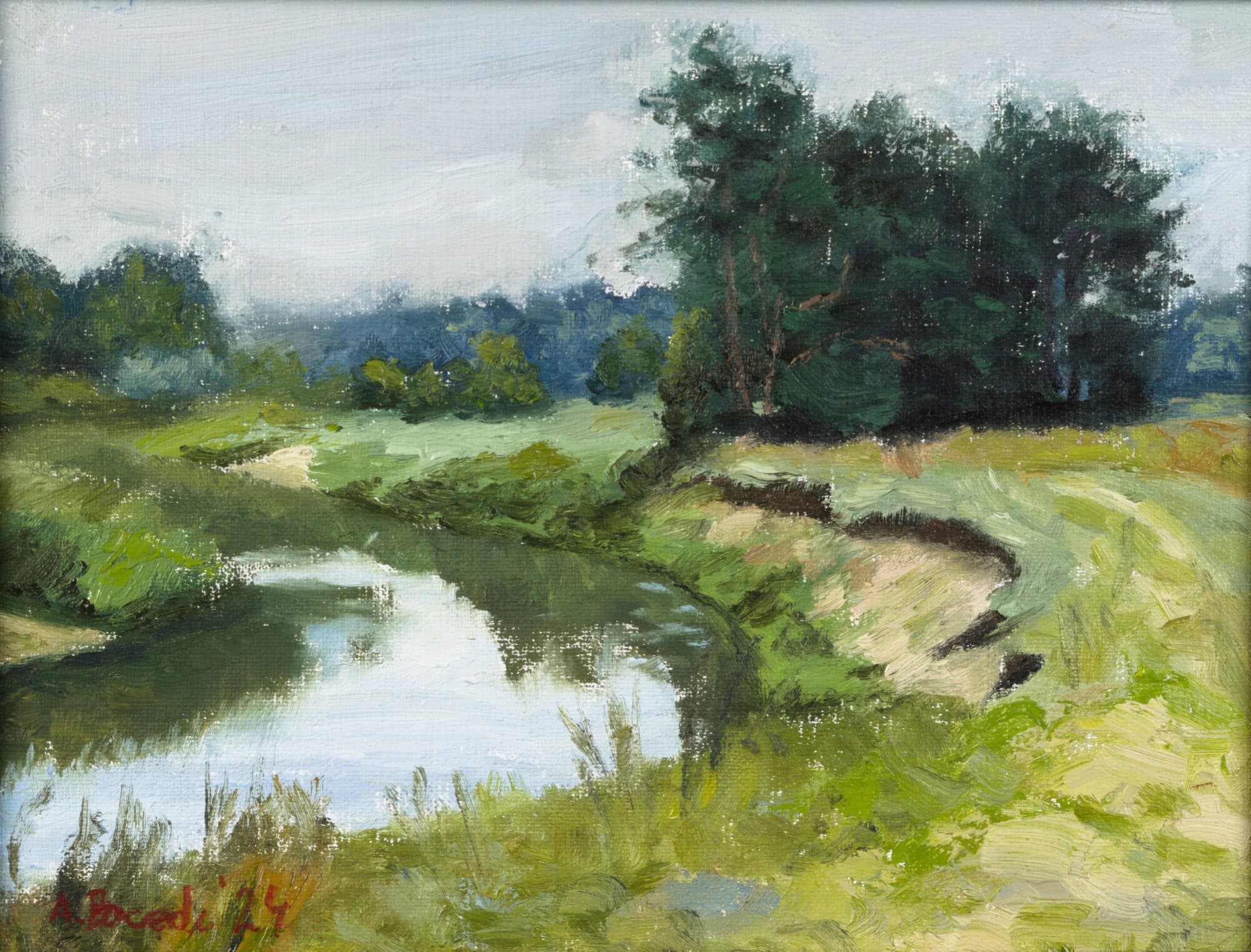
A riverbank.
A road.
A grey day.
A house standing alone in the countryside.
A line of trees at the edge of a meadow.
These subjects do not announce themselves as important. They do not demand attention in the way famous monuments or dramatic landscapes do. But for me, they often contain more painting than obvious views.
An ordinary place can hold a strange intensity when seen at the right moment.
This is one of the reasons I return to quiet landscape painting. I am interested in places that seem simple, but are not empty. They carry weather, memory, distance, silence and the passing of time. They do not explain themselves immediately.
The emotional weight of simple motifs
A simple landscape is never only simple.
A cabbage field under open sky can become a study of rhythm and space. A grey river can hold more atmosphere than a sunset. A small red house in a wide landscape can suggest isolation, presence, memory or stillness. A winter evening near a castle can become less about architecture and more about distance.
When I paint these subjects, I am not trying to make them impressive. I am trying to notice what is already there.
This is different from searching for a “beautiful view.” Beauty can appear anywhere, but it often appears indirectly — in proportions, in muted color, in the way a dark tree cuts through a pale sky, or in the moment when light briefly touches something ordinary.
Painting teaches patience with this kind of seeing.
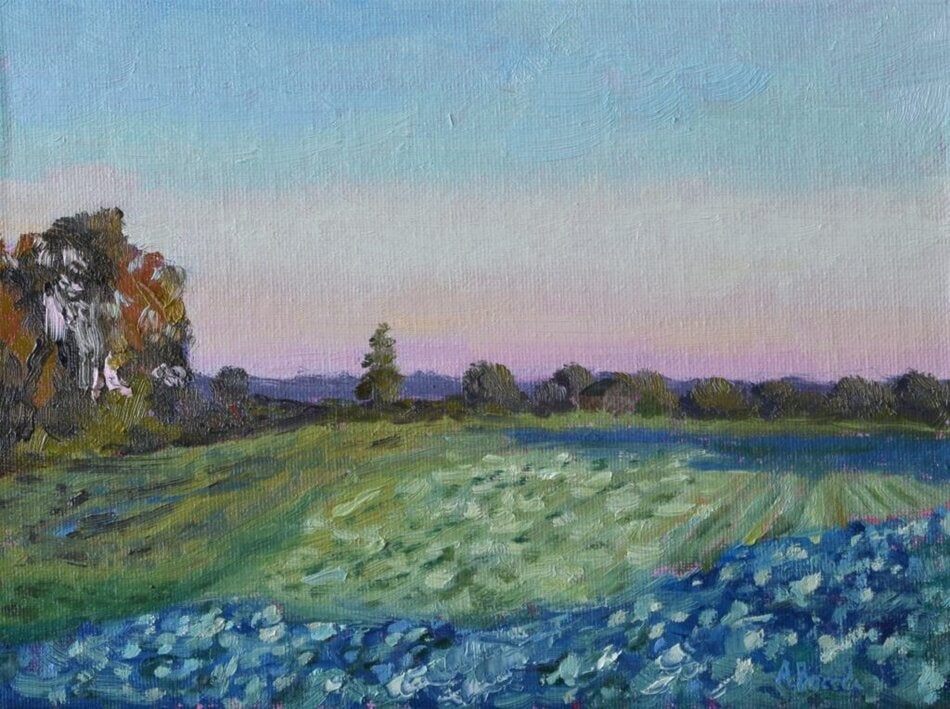
Why atmosphere matters more than detail
In my work, I often reduce detail.
This does not mean I avoid observation. On the contrary, reduction only works when it comes from looking carefully. The question is not how much can be added, but how much can be removed before the feeling disappears.
Atmosphere is built through relationships: warm against cool, light against dark, open against closed, movement against stillness. A painting can describe very little and still feel complete if these relationships are strong.
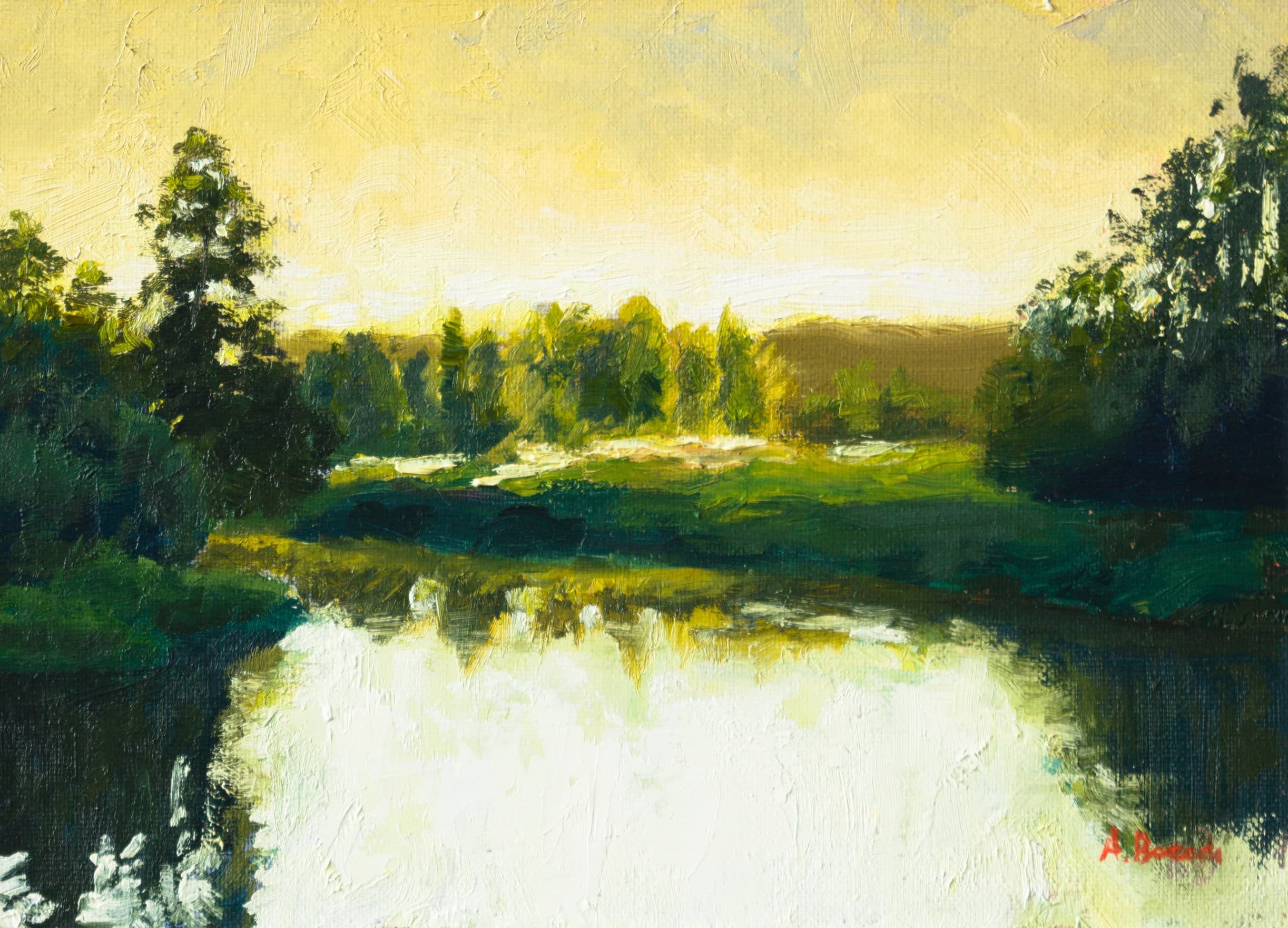
That is why I am drawn to oil painting. Oil allows a surface to remain alive. A brushstroke can suggest grass without explaining every blade. A sky can be built from temperature and pressure rather than smooth color. A road or river can appear through movement, not outline.
The painting becomes less literal, but more present.
The landscape as memory
Some places become important only after we leave them.
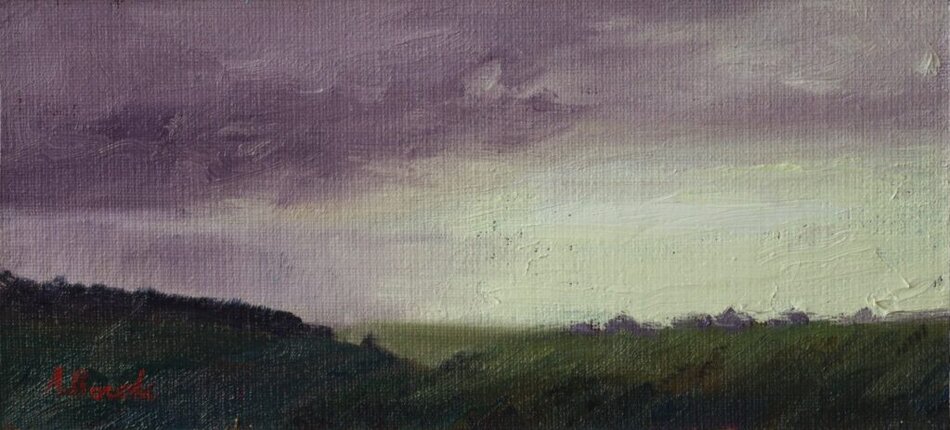
At the moment of seeing, they may seem unremarkable. Later, something remains: a color, a shape, a field under a certain sky, the dampness of winter air, the silence before rain. The memory simplifies the place but also strengthens it.
I think many of my paintings exist between direct observation and memory. Even when I paint from life, I am not only recording. I am already selecting. I am already transforming.
This is why an original landscape painting can feel familiar even to someone who has never visited the place. It does not need to function as documentation. It can touch a more general memory of land, weather and silence.
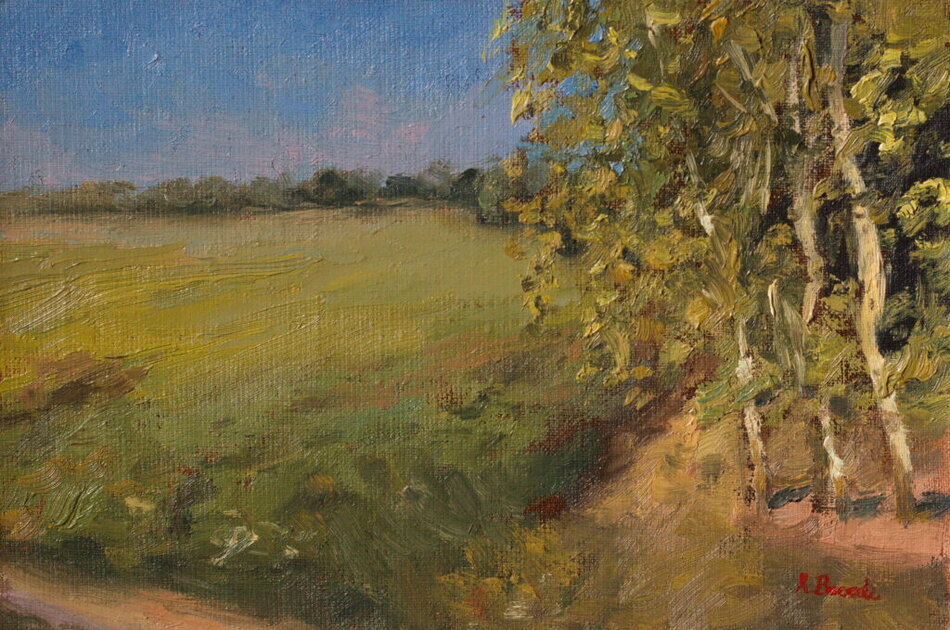
A collector may not know the Radomka River, a Polish meadow, or a specific rural road — but they may recognize the feeling of standing in such a place.
Quiet paintings in a loud world
We live surrounded by images that compete for attention.
Most of them are fast. They appear, disappear, and are replaced almost immediately. Painting belongs to another rhythm. It does not move, but it changes with looking. It asks for time.
Quiet landscape paintings can be especially powerful in an interior because they do not dominate the room aggressively. They create a point of stillness. They allow the eye to rest. They bring the outside world inside, but without noise.
For me, this is not passive.
Silence in painting can have force.
Stillness can have tension.
A small work can change the mood of a space precisely because it does not shout.
Original paintings and the value of presence
An original oil painting carries the time of its making.
Every surface decision remains visible: the pressure of the brush, the thickness of paint, the edge where one color meets another, the places where something was changed or left unresolved. These traces are part of the work’s life.
That is what separates an original painting from a reproduction or decorative print. A print may carry an image, but an original painting carries presence.
This presence is especially important in quiet landscape painting. The subject may be simple, but the object is not. The painting has weight, surface and individuality. It exists once.
For collectors, this matters.
For interiors, it matters too.
A one of a kind painting does not simply decorate a wall. It introduces another kind of time into the room.
Available quiet landscape oil paintings
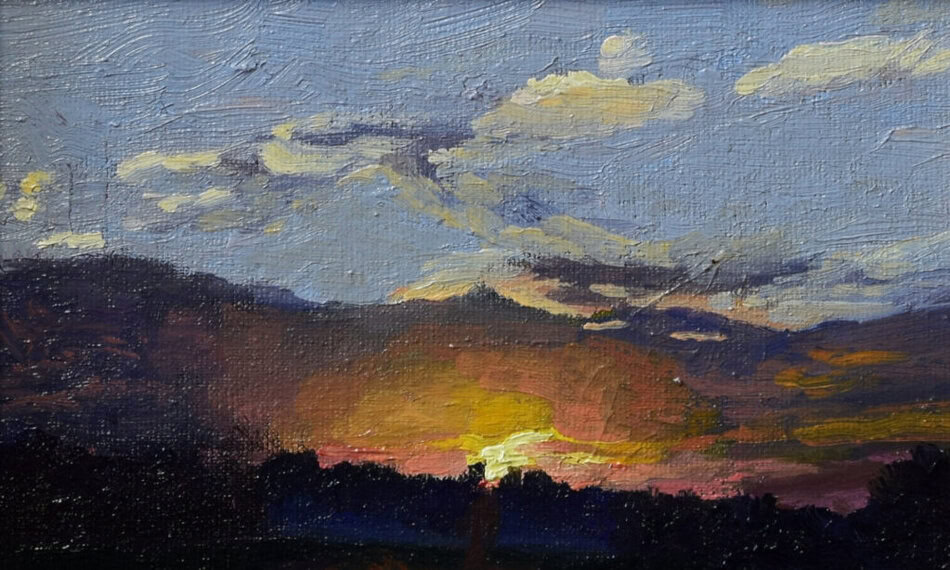
I keep a selection of original oil paintings available in my shop, including quiet landscapes, plein air studies, river views, fields, small rural scenes and atmospheric works from Poland, Italy and Sardinia.
Some paintings are connected with specific places. Others are more about mood, light and memory. All of them are hand-painted original artworks.
If you are looking for an original oil painting of a landscape — something quiet, atmospheric and personal rather than mass-produced — these works are made to be lived with slowly.
Available original paintings
Available paintings related to this article
Explore original works connected with this subject, place or painting theme.