
Architecture · Light · Perspective · Historic Places
Painting Historic Architecture in Oils
How light, perspective and painted surfaces shape my oil paintings of Italian towns, churches, historic streets and architectural details.
I rarely approach architecture as precise illustration. I am more interested in what a building feels like at a particular moment: the last sunlight touching a church facade, an entrance disappearing into shadow, warm stone against a blue evening sky or an old wall standing quietly within the surrounding town.
Why Architecture Works So Well in Oil Painting
Architecture gives a painting structure. Vertical walls, arches, doorways, towers and streets create a clear framework, while light and colour prevent the image from becoming rigid. A building can remain recognisable without every window, ornament or stone being described.
Oil paint is especially suited to these subjects because it can move between solid form and atmosphere. Dense passages can suggest stone, brick and plaster, while thinner paint can soften distant walls, evening skies and areas of reflected light.
In my own work, buildings often function as anchors inside a wider experience of place. They hold the composition together, but the real subject may be a shadow crossing a courtyard, the warmth of a facade, the stillness of a street or the way the surrounding air changes toward evening.
Painting Italian Architecture
Italian architecture naturally brings together structure, history and Mediterranean light. Places such as Venice, Monza and Tuscany contain buildings altered by weather, time and repeated human use. Stone changes colour throughout the day, plaster catches reflected light and decorative forms frequently dissolve into shadow.
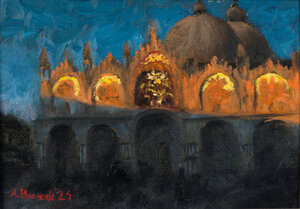
What interests me is not only the historical importance of a building, but its visual presence. The facade of San Marco can become a pattern of glowing arches against a darkening sky. A doorway in Monza can become a meeting point between warm stone, pale wall, vegetation and sharp sunlight.
These Italian architecture paintings are not intended as exact records. They begin with real places but are simplified and reorganised through colour, proportion, edges and the physical movement of paint.
Church Oil Paintings: Light, Silence and Vertical Form
Churches are powerful subjects for painting because their architecture is built around rhythm and direction. Towers, arches, columns, entrances and windows guide the eye vertically, while surrounding streets and shadows establish a quieter horizontal structure.
A church oil painting does not need to reproduce every architectural detail to retain the identity of the place. Sometimes a dark doorway, a warm strip of wall or the silhouette of a tower is enough. Simplification directs attention toward the strongest shapes, contrasts and intervals.
In San Gerardino , the architectural motif is closely connected with direct outdoor observation. The building is important, but so are the palm shadows, the warm entrance and the relationship between the facade and the surrounding sunlight.
Other church subjects appear in paintings inspired by Venice and Kazimierz Dolny. A chapel gate seen in summer light can carry both the identity of a historic site and the intimate scale of a small town.
Historic Building Paintings and the Passage of Time
Historic buildings contain visible layers of time. Walls are repaired, colours fade, surfaces become uneven and architectural details lose their original sharpness. These changes make old buildings especially interesting painterly subjects.
In historic building paintings, age does not need to be explained through narrative. It can be suggested through broken colour, softened edges, irregular surfaces and the relationship between the building and its surroundings.
The palace complex in Kozienice is a recurring local subject in my work. Its courtyard and historic outbuilding are not monumental in the same way as Venetian architecture. Their strength is quieter: pale walls, trees, open space and structures that have remained present through many changes.
Architecture as Interpretation, Not Illustration
Architectural illustration aims to describe a building accurately. Painting can do something different. It can remove unnecessary detail, alter colour relationships, deepen a shadow or simplify a street so that the visual character of the place becomes stronger.
This does not make the real location unimportant. The starting point remains observation: a particular building, a particular time of day and a particular experience of standing in front of it. The final work, however, is organised according to the needs of the painting rather than the demands of architectural documentation.
A building can identify a place immediately, but light determines how that place enters the painting.
Perspective, Simplification and Painted Surface
Perspective is necessary in an architectural subject, but it should support the image rather than dominate it. Too much mechanical accuracy can make a painting feel cold, while careless perspective can destroy the weight and stability of a building.
I usually establish the main verticals, angles and spatial divisions, then allow smaller details to remain loose. Windows may become short strokes, cornices may dissolve into light and distant ornaments may be suggested by broken marks rather than carefully drawn shapes.
The painted surface is equally important. Thick passages can give weight to illuminated stone, while scraped or thinly painted areas may suggest aged plaster, shadow or distance. These changes in paint handling prevent the architecture from becoming flat and diagrammatic.
Selected Architecture Paintings and What They Explore
The following works show several different approaches to architectural subjects: direct outdoor observation, evening light, historic facades, palace architecture and quieter local structures.
San Gerardino
A study of warm church walls, a dark entrance and palm shadows observed directly in Monza.
View the painting →San Marco
Saint Mark’s Basilica at dusk, with glowing golden architecture set against a deep Venetian evening sky.
View the painting →Palazzo Ducale
Illuminated Venetian architecture, dark lagoon water and broken evening reflections organised into a nocturne.
View the painting →Kozienice Palace Courtyard
A palace courtyard shaped by open space, trees, pale walls and changing natural light.
View the painting →Palace Outbuilding in Kozienice
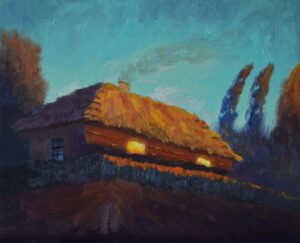
A quieter architectural fragment within the historic palace complex in Kozienice.
View the painting →Why Architectural Paintings Work in Interiors
Architectural paintings combine recognisable subject matter with strong formal structure. A church facade, palace courtyard or old street can create a clear focal point without functioning as generic decoration.
Small and medium works can fit naturally in studies, hallways, libraries, reading spaces and quieter living rooms. They may also carry a personal connection for collectors familiar with a particular city, region or type of historic architecture.
An original oil painting also has a physical surface that cannot be reproduced by a screen or print. Brushwork, changes in paint thickness and small irregularities remain visible when the work is seen in person.
Available from the studio
View Original Architecture Paintings
The dedicated collection page includes currently available paintings, prices, dimensions, detailed photographs, framing information and delivery options.
Browse Available Architecture PaintingsPainting Architecture in Oils: FAQ
What is an architecture oil painting?
An architecture oil painting is an artwork in which a building, street, church, facade, doorway or other architectural subject forms an important part of the composition. It may be precise and descriptive or more atmospheric and expressive.
How important is accurate perspective?
Perspective must make the building feel stable and believable, but a painting does not require the mechanical precision of an architectural drawing. Smaller details can be simplified once the main spatial structure is established.
Are these paintings based on real places?
Many of my architectural paintings are inspired by real places in Italy and Poland, including Venice, Monza, Kozienice and Kazimierz Dolny. The final painting may simplify the motif to concentrate on light, colour, atmosphere and composition.
Why is oil paint suitable for architectural subjects?
Oil paint can describe solid stone and plaster while also creating soft shadow, reflected light and atmospheric distance. Its flexibility allows architectural forms to remain structured without becoming rigid.
Where can I view available original architecture paintings?
Signed original works currently available are gathered on the architecture oil paintings for sale page. Each product page includes the painting’s size, medium, price, framing details and availability.
Explore Related Painting Collections
Continue with Mediterranean landscape and seascape paintings , explore paintings created outdoors , browse original landscape oil paintings or visit the complete painting archive .
Available original paintings
Available paintings related to this article
Explore original works connected with this subject, place or painting theme.